Blog

Notes on managed services and IT delivery

Things I've learned running managed services, cloud and application support for enterprise clients.

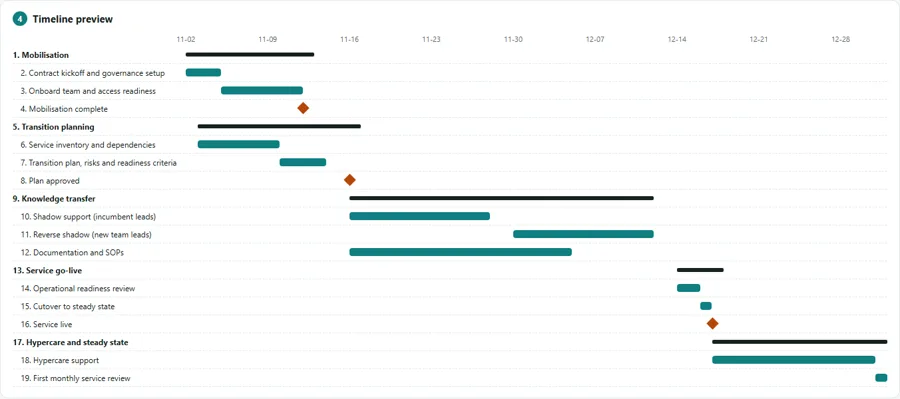
Project Plan Builder timeline preview

I was asked to write a project plan from memory, against the clock. So I built a tool anyone can use.

An interview test asked me to plan a project without any planning tool, under time pressure, with resources on leave and a QA tester unavailable. It made me ask a better question for the AI era: how fast can you turn what you know into a working plan?

In this post

  • The interview test and why I think the question should change in the AI era.
  • Project Plan Builder: a free, open-source planner in the browser with leave, rates, dependencies and one-click export to MS Project.
  • Who it helps: people new to MS Project, teams without a licence, and PMs who want a fast first draft.
  • How you can help grow it as open source.
Read the post
Cover image: A Complete Guide to Managed Services

A Complete Guide to Managed Services: Effectively Boosting IT Efficiency and Security

Most companies don't have the people or budget to run their own IT around the clock, and that gap shows up as downtime, security holes and teams stuck firefighting. This guide explains what a managed service provider (MSP) actually takes off your plate, where it pays for itself, and how to tell a good provider from one that will just sell you tickets.

What the article covers

  • The problems MSPs solve: thin in-house expertise, the cost of a full IT team, downtime risk and fast-moving cyber threats.
  • What you get: continuous monitoring, fixed monthly costs, stronger security, room to scale and access to certified specialists.
  • Ten common service types, each with a real-world use case: network, cybersecurity, cloud migration, backup and DR, help desk, compliance and more.
  • How to choose a provider: relevant experience, tailored services, clear SLAs, a proactive approach, flexibility and 24/7 support.
  • Where the industry is heading: AI-driven automation, stronger threat detection and cloud-first operations.
Read the full article on royalcyber.com